
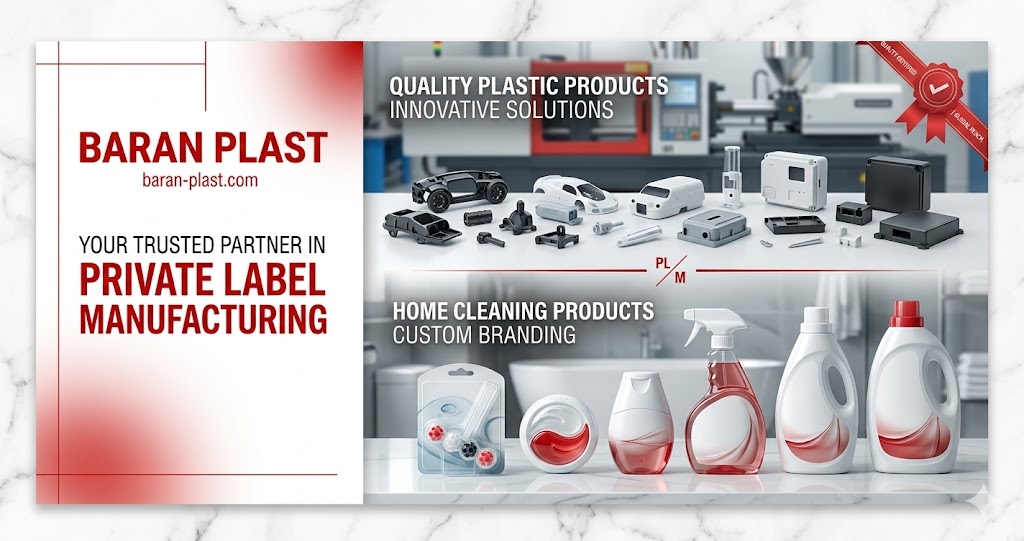
In the automotive aftermarket, suppliers are judged by more than price. Buyers look for consistency, category depth, product fit, and the ability to respond to demand without creating delays across the supply chain. That is why manufacturers with a clear production focus and a structured catalog tend to stand out. Baran Plast presents itself as a company built around injection molding and the production of automotive spare parts and chrome accessories, with roots going back to 1994. On its official company profile, Baran Plast states that it has served multiple industries including electrical parts, white goods, construction, automotive spare parts, and cosmetics, while keeping customer satisfaction, trust, and continuous development at the center of its operations.
That matters because long-term survival in manufacturing usually signals operational discipline. A company does not remain relevant in technical production by relying on slogans alone. It remains relevant by delivering usable products, maintaining tooling standards, adapting to market changes, and preserving buyer confidence over time. Baran Plast also states that it follows technological developments closely and positions its plastic product line in both the Turkish and European markets. That gives the brand a practical industrial profile rather than a purely promotional one.
A Manufacturing Identity Rooted in the Aftermarket
The automotive aftermarket is a demanding environment. It requires suppliers that understand not only production, but also replacement cycles, compatibility needs, and distributor expectations. Baran Plast’s official site is structured around two main business lines: Spare Parts and Chrome Accessories. The site also includes a B2B Dealer Login and a searchable product interface built around “thousands of parts,” which indicates that the company is oriented toward professional sourcing rather than only basic brand presentation.
This is an important distinction. Many companies look credible at a glance, but their digital presence does not support real procurement behavior. A supplier serving workshops, distributors, exporters, or wholesalers needs a clearer structure. Buyers want fast navigation, category-based access, and product grouping that reflects the logic of actual aftermarket purchasing. Baran Plast appears to understand that requirement and has built its online presentation around it.
Product Breadth That Supports Real Market Demand
One of the strongest signals on the Baran Plast site is the range of visible product groups. The public catalog references categories such as mirror covers, trunk badges, mirror and fender signals, air vents, outer and inner door handles, seat adjustment handles, grille badges, radiator, engine and oil caps, wiper blades and arms, bumper brackets, gear knobs, oil rods, and fuel tank caps. This is not a narrow one-product operation. It is a broader aftermarket parts supplier with both functional and appearance-related product lines.
That breadth creates clear commercial advantages. A buyer looking for one-off products may tolerate a specialized niche supplier. A buyer managing recurring orders usually prefers a company that can cover multiple categories at once. The broader the usable catalog, the stronger the supplier’s value in consolidated sourcing.
Why broad product coverage matters
- It reduces the need to work with too many separate vendors.
- It improves order efficiency for distributors and wholesalers.
- It supports repeat business through a wider purchasing relationship.
- It makes the supplier more resilient against shifts in demand for any one category.
- It strengthens the company’s position in regional and export-oriented aftermarket trade.
Those are not cosmetic benefits. In B2B automotive trade, range translates directly into purchasing efficiency.
Built for Compatibility Across Multiple Vehicle Brands
Baran Plast also appears to serve a broad cross-section of vehicle makes. Its public-facing product search references brands including Audi, Citroën, Dacia, Fiat, Ford, Hyundai, Iveco, Kia, Mercedes, Nissan, Opel, Peugeot, Renault, Toyota, and Volkswagen, among others. That suggests a multi-brand aftermarket strategy rather than dependence on a narrow vehicle segment.
This matters because compatibility breadth is one of the most practical indicators of supplier relevance. A catalog that touches many vehicle brands is more useful for distributors, resellers, and importers that need flexible stock options. It also means the manufacturer is participating in a wider replacement-parts ecosystem instead of serving only one small corner of the market.
What buyers usually value in a multi-brand supplier
- Easier one-stop sourcing for several vehicle lines.
- Better inventory planning across mixed customer demand.
- Stronger resale potential for regional distributors.
- More room for long-term account development with the supplier.
- Reduced friction when expanding into new market segments.
A supplier with cross-brand relevance is simply more useful to professional buyers.
Chrome Accessories Add a Commercial Edge
Baran Plast does not position itself only as a technical spare parts producer. The company also highlights chrome accessories as a core line on its official site. That is strategically relevant because the aftermarket is not driven solely by repair needs. Appearance, customization, and visual enhancement remain strong buying drivers in many markets.
This dual focus is commercially smart. Spare parts serve replacement demand. Chrome accessories serve visual and retail-driven demand. Together, they create a stronger product mix.
The value of combining spare parts and accessories
- Spare parts answer maintenance and replacement needs.
- Chrome accessories address style and finishing preferences.
- The mix broadens the company’s buyer base.
- It supports both workshop-oriented and retail-oriented channels.
- It creates more cross-selling potential within one supplier relationship.
That combination makes a manufacturer more flexible in the aftermarket economy.
Credibility Through Industry Presence
A company’s public presence in recognized trade events often says more than generic marketing language. Baran Plast appears in the Automechanika Frankfurt 2024 exhibitor listing, where it is presented under its company identity and linked to product areas such as Mirror Cover and Door Handle. The listing also shows the company’s address in Başakşehir, Istanbul, Türkiye. Automechanika Frankfurt is one of the major international meeting points for the automotive aftermarket, so visibility there is a meaningful signal for buyers assessing industrial credibility.
This type of presence matters in practical terms. Buyers evaluating suppliers want evidence that the company is active in real industry channels. Trade fair participation suggests that the business is engaging with international buyers, presenting product lines in a professional environment, and operating with enough confidence to place itself in a competitive global marketplace. That is more persuasive than inflated website language.
Why Baran Plast Has a Relevant Position Today
The aftermarket is increasingly shaped by speed, fitment accuracy, category management, and supplier reliability. Companies that can combine manufacturing capability with catalog clarity have a stronger chance of building durable commercial relationships. Based on its official site and exhibitor profile, Baran Plast is positioned around exactly those strengths: injection molding experience, a long operating history since 1994, a two-track focus on spare parts and chrome accessories, searchable product access, and visible participation in the aftermarket trade environment.
For the right kind of buyer, that positioning is useful. The company is relevant to:
- automotive spare parts distributors,
- importers and wholesalers,
- aftermarket retailers,
- regional sourcing partners,
- and buyers looking for a broader category supplier rather than a single-product vendor.
Conclusion
Baran Plast presents the profile of a manufacturer that is more industrial than decorative in its business logic. Its public materials point to a company founded in 1994, active in injection molding, focused on customer trust and continuous development, and structured around both automotive spare parts and chrome accessories for broad aftermarket use in Turkey and Europe. Its searchable catalog, multi-brand relevance, and appearance in Automechanika Frankfurt 2024 reinforce that position.
For baran-plast.com, the strongest content direction is not exaggerated sales language. It is a clear B2B positioning: a manufacturer and aftermarket supplier built on range, production continuity, and practical sourcing value. In this industry, buyers do not need flashy promises. They need competence, structure, and confidence that the supplier can deliver. Baran Plast has the right foundation to be presented that way.